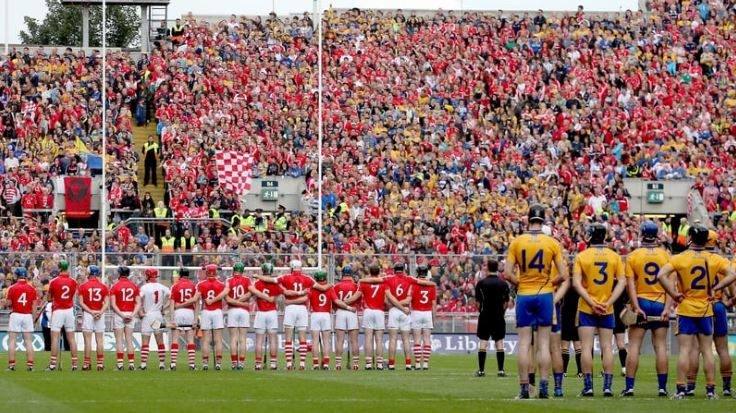
We’d seen it all before. We’d lived it all before. “It’s Cork’s to lose now, twenty to go they’re seven up” uttered Duignan in the commentary, as Harnedy notched his fourth. We didn’t have to be told Michael. For six years, Nicky Quaid’s save from Harnedy has been nestled in the brain, this intrusive memory that refused to wane with the passing of time. Life went on and with it this sporadic reminder of what could have been. “We’d have beaten Galway too” you’d find yourself muttering to nobody in particular as you carried on with life’s mundanities. Then he did it again, the dastardly Quaid, saving from Hoggy with two between the teams and four minutes to play. Six years ago, Limerick went down the other end and won a free to put them a point up. On this occasion, Limerick went down the other end and Aidan O’Connor’s effort sailed just wide. Moments earlier, Shane O’Brien had a similarly gilt-edged chance to reduce the deficit to a minimum. He missed too and, in the end, that was the difference. We thought we’d experienced catharsis and the purging of our souls against Kilkenny in 2021. Turns out, we hadn’t. This just feels different. It’s been that kind of year.
I’ve written before about the butterfly effect of that Nicky Quaid save and what might have transpired had Harnedy found the net. Similarly, should Cork go on to do the business tomorrow, there certainly won’t be a shortage of ‘what if’ moments to reflect upon over the coming weeks and months. What if Tipperary’s Alan Tynan didn’t manufacture that free at the death against Waterford? What if Kyle Hayes kept his cool and opted instead to let Shane Kingston take his chances? What if the umpire’s cognitive coin toss landed the other way above in Ennis? Had any one of these scenarios played out differently, the likelihood is that Cork wouldn’t have progressed out of Munster, neither of those seismic victories over Limerick would have occurred and talk of the famine would have trickled agonisingly into a twentieth year.
That being said, it would be wholly unjust to undermine the merits of Cork’s place in the All-Ireland final as a mere byproduct of lucky breaks. We’ve been on the opposite side of that bounce too in recent years. Cast your mind back to some questionable refereeing calls in the Gaelic Grounds last year, for instance, that put paid to our season’s ambitions. But as Maurice Brosnan of the Examiner so rightly alluded to last week, this Cork team are where they are now due to the simple fact that they have “constantly put themselves in contention for it”. This, as we all know only too well, was not always the case. Even putting results to one side for a second, the single greatest feat of Pat Ryan’s tenure to date has been his complete flipping of the perception surrounding Cork hurling and in putting to bed the cutting appraisals that have been associated with this team, and indeed previous iterations, for well over a decade.
All of which isn’t to say that such judgements weren’t warranted, of course. For far too long, Cork were physically and mentally soft. Cork were erratic and unreliable. Cork did struggle to win primary and secondary ball, especially from their own puck out. All of this was patently true and in an interview with Denis Walsh way back in February of last year, Ryan indicated his desire to “bring more hardness into it” while remaining true to the more traditionally aesthetic facets of Cork hurling. “It’s very obvious we need to get more physical in what we’re doing, but we can’t go away from what we’re good at too.” A year and a half later and the difference between what we were and what we are is almost unfathomably stark.
Cork enter into tomorrow’s decider on the back of five consecutive championship victories, a level of momentum-swelling consistency not seen since the heady heights of the mid noughties. They bring with them an arsenal of attacking options that marries beauty and belligerence and feeds off long, direct deliveries from Patrick Collins. All of this was simply unthinkable in the not too distant past. “Cork do pose a different threat, especially with their big men up front”, warned Anthony Daly only this morning. Did we ever think we’d see the day? Walsh Park was only thirteen weeks ago, after all. Cork are simply a different proposition now. How often has it been said that Cork would fancy themselves if the game develops into a shootout? Well, I don’t think many would back against us in a dogfight now either. Now, we (this blog included) might have said this all before. Think of Clare in the Gaelic Grounds in ’21, or after Waterford in Walsh Park in ’22. This just feels different. It’s been that kind of year.
And it’s on the back of this transformation that the support has swelled into a maniacal surge of fervour and adoration, a reflection on the team’s newfound defiance and tenacity, the kind of intangible qualities that creates such a passionate symbiosis. The piercing roar that greeted Dalton’s point from the ends of the earth against Limerick was as much in response to Joyce’s hook on Gillane that preceded it. That hook wasn’t always there. It certainly wasn’t there in 2013. Back then, we travelled up in cautious expectation, knowing deep down in our heart of hearts that not even JBM’s messianic presence could protect against the team’s very evident shortcomings. In 2021, we travelled up with nothing more than hope, Covid restrictions and the impending obstacle of the all-conquering Limerick dampening any mass frenzy in the build-up. This just feels different. It’s been that kind of year.
Ever since that night of nights down the Páirc and the subsequent annexation of Thurles, Cork’s season has assumed an almost fated air. Somehow, when the music stopped in Munster, we were still standing and the whole world had opened out in front of us. Destiny dictated that it just had to be Limerick in the semi-final again and that it would have to play out just as it did, in such a chillingly recognisable manner. And the cosmos ordained that it just had to be Clare in the final once again. Eleven years on from that sideline that should have been bundled into the corner, those additional few seconds conjured out of nowhere and ultimately, that “Holy Moses” score from a Clare corner back that hasn’t been seen or heard from since. Another demon to conquer then. Another traumatic episode that can only be overcome through the act of retribution and one final liberating triumph.
So, how does this all end? The natural, quixotic conclusion to such a season should see Patrick Horgan finally reaching the summit at the expense of the crowd that so cruelly robbed him of his crowning glory over a decade ago. All the while, he becomes the highest scorer in the history of the game. We all know that this is how it should play out. But we’re also long enough in the tooth to know that competitive sport rarely bows to the romantic narrative, that fairy tale endings are the exception and not the rule.
Then again, this just feels different. It’s been that kind of year.
Up the Rebels.
 Bold Thady Quill
Leave a comment