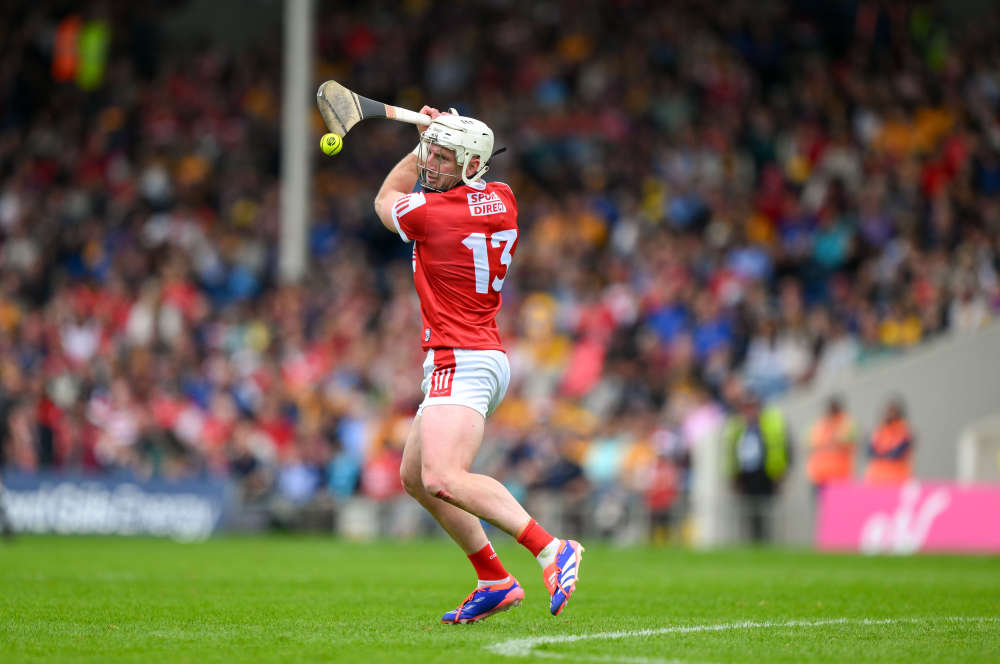
When Patrick Horgan claimed his fourth and final All-Star in November 2019, he drew level with Cork royalty such as Ger Cunningham, Denis Coughlan and Diarmuid O’Sullivan. Only John Fenton, Tony O’Sullivan and Jimmy Barry-Murphy ever collected more on Leeside. Yet what sets Horgan apart from that gilded company is not what he has, but what he lacks. If Celtic Crosses are the only accepted legal tender for entry to the pantheon inhabited by Fenton, Barry-Murphy et al, where does that leave a man who for the best part of two decades, has bestowed such greatness on the hurling world?
Those 2019 awards also placed Horgan among a select band of tragic heroes, figures whose brilliance was betrayed by circumstance. Limerick’s Gary Kirby bowed out with four All-Stars but no medal. Galway’s Ollie Canning shared the same fate. Waterford stalwarts Michael Walsh and John Mullane stood alongside them, with Mullane’s five All-Stars marking him as the most decorated hurler never to climb the steps of the Hogan Stand on All-Ireland final day. These men have become part of hurling’s tragic folklore – Kirby and Canning overtaken by time before their counties ended long famines, Walsh and Mullane forever haunted by Waterford’s Croke Park heartbreaks.
But in an era of unprecedented scoring, Patrick Horgan emerged as one of the most accomplished practitioners of the craft. However, while the remainder of the Class of 2008, namely TJ Reid, Seamús Callanan and Joe Canning (all four made their championship debuts within twenty days in June ’08) all reached the Promised Land, Horgan and Cork continued to wander the desert.
For a fleeting moment in 2013, less than two minutes, paradise beckoned. The clock had slipped into injury time when Christopher Joyce’s sideline cut found Horgan. Until then, he had been a shadow on the game’s edge, enduring 37 long minutes without a touch in open play. It mattered little. Two touches, crisp and instinctive, and his man was spun. Most players in such an instance, hemmed in by two Clare defenders, susceptible to a hook from behind and a block from the front, would have ran at the opposition, hoping to create space or at the very least, draw a free. But of all the gifts bestowed upon Horgan, of all the attributes honed on the playing fields and ball alleys of Blackpool, pace was never one of them.
In its stead came something rarer, an elasticity of wrist that removed the necessity for backlift and erased the need for daylight. With a nonchalance that defied the gravity of the situation, he flicked the ball over the bar, nudging Cork in front. Hoggy encapsulated. A moment conjured from nothing and executed with sheer finesse. A point worthy of winning any All-Ireland Final but one that will be forever overshadowed in the annals of history by Domhnaill O’Donovan’s subsequent effort. “Hurling,” Anthony Daly once said, “a thousand mad things and someone comes out on top.” The madness of that finale in 2013, one hundred and something seconds that altered fates, still lingers, a sliding-doors torment for Cork hurling souls.
It’s scarcely believable now, but while Patrick Horgan’s precocious talents were known to all, in certain quarters it was his namesake Cronin who was rated more highly. Cronin’s Bishopstown had dominated underage hurling in Cork for much of the mid-Noughties, claiming minor titles in ’02 and ’03 as well as U-21 honours in ’06 and ’07. Captaining the Cork minor’s in ’05, he scored 1-10 in the Munster final defeat of Limerick before playing a leading role in Bishopstown’s 2006 Premier Intermediate success and cementing his status as a player capable of lessening the burden on Niall McCarthy in an otherwise lightweight Cork attack.
The Kilkenny behemoth of the time were changing the landscape of inter-county hurling, their directness and unmatched physicality having surpassed Cork’s impish running game as the template for success. “Hurling savagery” as Ger Loughnane described it. The general consensus was that unless that ‘savagery’ was matched, Kilkenny’s ferociousness would always supersede the more aesthetic elements of the game. The days of the elegant corner-forward had been consigned to the past it seemed. And the jury was out on whether Horgan could survive in this new age.
“History had it’s moment in Pairc Ui Chaoimh yesterday” read the opening line of the Irish Times match report on Cork and Tipperary’s encounter on June 8th 2008, its significance owing to Tipperary ending an 85-year losing sequence against their old foes on Leeside. The other post-match talking-points focused on Cork’s abject second-half performance as well as the issue of overcrowding at the Blackrock End which resulted in 400 fans being led onto the pitch to avert a crush. What we didn’t know at the time however, was that we had just seen two of the greatest marksmen of the ensuing decade take their fledgling steps on the inter-county scene.
Seamus Callanan would make hay from centre-forward that day, notching three points on his championship debut for Tipperary. At the other end, Cork’s offensive malfunction saw five of the starting six forwards called ashore, Patrick Horgan making his intercounty bow as a late replacement for Niall McCarthy when defeat was all but assured. A first senior championship point came a month later, the last score in an unconvincing Qualifier victory over Dublin, a game which seemed to endorse the belief that the end was nigh for the great Cork team of the Noughties.
Indeed, the subsequent victory over Galway would prove to be the last great deed of a dying team. Horgan was introduced to the fray at half-time, his side two points and a man down to a Galway side already heavily reliant on another precocious talent, “the one sharpened blade in a gunfight”, as Tom Humphries had dubbed him. Joe Canning had run amok in the first-half, turning the Rock to rubble and confirming his greatness a mere three games into his maiden season. Ultimately though, Cork would win by two, inspired by Joe Deane in his final season. For Galway, 2008 marked Canning’s coronation — Young Hurler of the Year, and already the patriarch of a team starved of leaders. Horgan’s induction wouldn’t be as seamless.
Horgan’s initiation to Cork hurling was completed in 2009 when he became accustomed to its off-field travails, an acrimonious strike consigning yet another season to spoilage. By 2010, however, the skies had cleared and Horgan began to assert himself as a prominent marksman, dovetailing effectively with Aisake O’hAilpin and pilfering two goals in the ten-point destruction of Tipperary in the opening round of the Munster Championship. Yet the game was continuing to change at pace, the gladiatorial intensity of the ‘09 All-Ireland Final demonstrating that forwards no longer had license to rely solely on their scoring returns. With free-taking duties still entrusted in Ben O’Connor, accusations arose that Horgan’s in-play contributions were insufficient, a charge he would never quite escape.
Cork were enduring a period of turbulent transition at best, a period of steady decline at worst. Yet amid the uncertainty, Horgan began to establish himself as one of the country’s stand-out assailants. And in doing so, the Glen Rovers man quickly became one of the side’s more experienced players, his progression accelerated by the vast turn-over in playing personnel. The gradual decommissioning of the mid-Noughties side was bound to be an arduous task, one exacerbated by the apparent paucity of talent coming through to replace it. Between 2010 and 2013, stalwarts such as Ronan Curran, Niall McCarthy and the O’Connor twins all departed the scene, while Donal Og Cusack, John Gardiner and Sean Og O’hAilpin were ushered out with a little less diplomacy.
By the time Cork took the field to play Clare in the opening round of the 2013 Munster Championship, only Anthony Nash, Brian Murphy and Tom Kenny had made their debuts before Horgan. Of the rest, only Stephen Moylan, William Egan and Luke O’Farrell had experienced any degree of underage success, while relegation from the top tier of the National Hurling League seemed to reinforce the idea that this was a team on a downward curve. The volatility of the 2013 was unforeseen, a throwback to the Revolution Years of the mid-90’s. For most, the championship is remembered fondly as one of the most magical in the GAA’s history, awash with drama and unpredictability. For Horgan and the rest of Cork’s hurling community however, those memories are tinged with anguish, regret and a sense of ‘what could have been’. A first All-Star award provided an opioid to the pain for Horgan while the patrons on Leeside could at least take some solace in the pervading hope that Cork had re-emerged as one of the powerhouses of the game. It would prove to be yet another false dawn.
If the progress of 2013 suggested that a sleeping giant was finally awakening from a lengthy slumber, the years that followed would rewrite the narrative. Although Horgan and co. would atone for the year previous in 2014, defeating Limerick in the Munster decider, a wretched All-Ireland semi-final performance against Tipperary debunked the cliched ‘Mushroom Theory’ that had permeated back into Cork hurling lexicon. Cork were by now in the throes of an underage development crisis, the drought on a national scale dating back to 2001. At senior level, the knock-on effect was evident, the regression in the performance of established players undoubtedly owing to the dearth of competition. By the end of 2016, Horgan’s scoring average from play in championship had dropped to below two points per game. It didn’t take long for those old accusations regarding the efficacy of his game to gain traction once more.
In the February of 2017, Cork manager Kieran Kingston dropped Horgan, opting for stick over carrot to coax more out of his talisman. For the first time in almost six years, Cork lined out in a competitive game without Horgan. The stick worked, extracting from him a level of performance that in the years that followed, saw him occupy a different stratosphere to many of his peers. Scoring four points from play in the unexpected championship defeat of Tipperary, Horgan continued his stellar form throughout the summer, over-taking Christy Ring as Cork’s all-time championship record scorer in the Munster Final defeat of Clare. Any allegations of an over-reliance on placed balls were soon suppressed. 2018 would follow a similar trajectory, provincial honours and an All-Star doing little to quell the frustration of another All-Ireland semi-final defeat, the sixth of Horgan’s career.
If intercounty hurling was gradually becoming No Country for Old Men, Horgan refused to be pigeon-holed as the protagonist struggling to adapt to the changing world. 2019 was unquestionably his best, a new-found proclivity for goal-scoring demonstrating that some old dogs can indeed acquire new tricks. Having only scored fourteen goals in eleven seasons prior to ‘19, Horgan added seven more to his tally over the course of that summer. His virtuoso display against Kilkenny in that year’s All Ireland quarter final seemed to distil the paradox of his intercounty career — moments of individual brilliance set against the unrelenting backdrop of collective disappointment.
If 2017–19 marked Horgan’s Indian summer, the winters that followed still produced their flickers, reminders that his craft and guile could never be held subordinate to the game’s ever increasing reliance on power, pace and pragmatism. Flickers were never quite enough though. Another final came and went in 2021, by which stage the “Hoggy Conundrum” had become the very symbol of Cork hurling’s philosophical divide — the eternal tug between the fanciful and the fundamental. In 2022, after striking a goal against Galway in the league, Horgan pressed a finger to his lips, the universal signal that, in his mind at least, the doubters had been silenced once more. But Father Time can never be shushed.
It is a measure of the man that, three years on, the Conundrum still lingered, a testament to his cerebral genius, and to the way that brilliance so often obscured his own limitations. His goal against Clare in the 2024 Munster round-robin defeat, an audacious lob over Éibhear Quilligan, felt like the last unfiltered act of a true maverick. The All-Ireland finals that followed offered no such indulgences, their unforgiving rhythms leaving no room for flourishes of that kind. Horgan’s role was reduced instead to that of free-taker, a peripheral figure rather than the game-shaper he had once been. And when even those frees began to drift wide, you couldn’t help but wonder if the juice was still worth the squeeze.
In the end, Patrick Horgan’s greatness was defined not by medals, but by moments of magic — moments that will endure long after the records are forgotten. The final curtain may have fallen without the Celtic Cross we all craved, but his ovation will echo all the same. He left the stage owing us nothing.
 Bold Thady Quill
Leave a comment