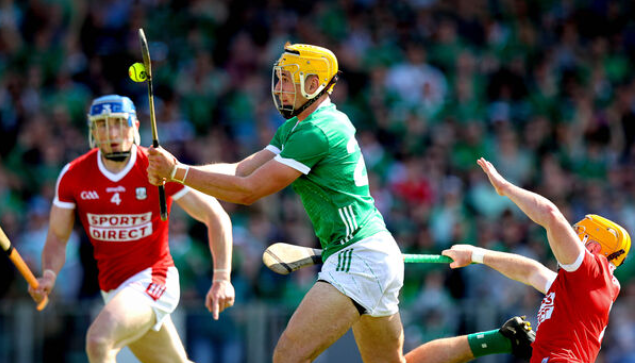
Ten years ago, when Cork defeated Kilkenny in the All-Ireland quarter-final, a wave of excitement rippled through the hurling world. Ding dong the witch is dead. Kilkenny had shown signs of weakness in the three games prior to that, losing to Dublin before being brought to the brink by Tipperary and Waterford. The fatal blow landed by Cork instilled a level of unpredictability in the championship that not many would have envisaged at the start of that summer. Just like that, it was anyone’s game. In the build-up to the meeting between Cork and Limerick last weekend, and at fleeting moments throughout the game, it looked as though history might repeat itself; that the walls of an imperial power might come tumbling down, the gates blown wide open. The marginal calls went in Cork’s favour that day in 2013 (remember Shefflin’s first-half sending off?). This time, they didn’t.
It says something about Cork’s current standing in the game that the majority of onlookers were hoping for a Rebel victory. And it is to Limerick’s eternal credit that they have become the team that everyone wants to lose. Had they done the decent thing and rode off into the sunset after 2018, nobody would have begrudged them. Instead, much like their dynastic predecessors a decade before, they’ve learned that you either die a hero, or live long enough to see yourself become the villain. The week leading up to last weekend’s do-or-die encounter saw us fervently trying to wish rumours of their in-house squabbling into reality. Instead, Limerick produced their best performance of the summer and the player for whom all sorts of infractions were conjured up to account for his apparent jettisoning produced an imperious final twenty minutes that ultimately swung the game in their favour. So, Limerick’s hurling campaign will progress into the summer months. Still standing, still champions, still the team to beat. And it’s Cork who are left to rue what might have been after two epic battles that teetered on a knife-edge right up to the final whistle. A chasm of fortunes decided by the finest of margins.
It offers scant comfort to touch on the fact that since the inception of the Munster round-robin in 2018, no other team has come close to being eliminated having played so well. Much has been said and written about the dog-eat-dog nature of the provincial championship, but it is worth noting that the competition has also been contested by its fair share of duds. In 2018, Waterford and Tipperary failed to win a game, with the Déise repeating the trick the following season. Last year, Tipp played their part as the abject also-ran, while Waterford’s season careered off a cliff once more (the problem can’t just be Davy?). Three into five may seem unforgiving but in reality, the inclusion of at least one truly awful team in each of the four iterations so far has rendered the competition far less precarious than it seems. Cork were not awful this year, far from it, but when you fail to win three decisive games that were there for the taking, it’s only right that you pack your bags. Two one-point defeats away from home against the best two teams in the country are still, at their very essence, two defeats. So there can be no complaints. Such is life.
Our aspirations from the outset of this year’s championship were for signs of progress, the most tangible of which would have been an All-Ireland semi-final berth and the emergence of one or two stand-out performers. We failed to achieve the former while our realisation of the latter is still very much up for debate. Having given ample game time to close to thirty players over the course of the league, Brian Roche, Eoin Downey and Tommy O’Connell were the only debutants entrusted with starting berths come championship. Roche was by far the most impressive of the three but his undulating performances across the four games provided a stark reminder of just how difficult it is for a newcomer to survive and thrive at championship altitude. This isn’t helped by the decay of the national league into sheer irrelevance which coupled with the high-octane environment that exists in Munster at present allows little in the way of acclimatisation. Man of the match against Waterford? Good man, now go out and pick up Noel McGrath in six day’s time. Good stuff against Clare Brian but forget about it now, you’re marking Kyle Hayes next week. The challenges are unrelenting and inconsistency can only be expected.
With all this in mind, one championship season offers far too shallow a sample size to fairly assess the capabilities of the aforementioned trio, among others like Brian Hayes, Pádraig Power or Ethan Twomey. Sure, many of us still haven’t made up our minds over players that have years of extractable data from which to stake a convincing claim one way or the other. And this is by far and away the most disappointing aspect of our early-season elimination. Not the newcomers or lack thereof. And certainly not the old dogs like Horgan and Harnedy that continue to trudge the hard road with no signs of stopping. But rather it’s the inbetweeners. The players that have been around long enough now that we should know for sure what they’re truly made of, the players for whom the benefit of doubt so generously afforded to them by supporters and management alike must be in short supply. Can you really hang your hat on a player upon which the tag of ‘impact-sub’ has been bestowed? Can you really continue to roll the dice on a player whose feast to famine ratio is only going in one direction? Can you really persist with a very competent keeper but one that just doesn’t seem likely of ever exhibiting the watertight assuredness that is required of such a position? Harsh appraisals perhaps, but it’s the hard answers to hard questions that may come to define Pat Ryan’s tenure.
You’d imagine that Ryan will have no qualms about doing just that. In one year, he’s transformed a group of players that for years has been considered a soft touch into a team that above all else, has exuded an air of defiance. For all the good work laid down by the likes of Kingston and Meyler, neither ever seemed capable of making their teams consistently hard to beat. In three of the four games, Cork were the inferior team. And in three of the four games, that almost didn’t matter. That inferiority won’t last long either. The change in Cork’s playing style this year was evident, with an emphasis on directness that yielded crucial scores at crucial stages. The quality of delivery and more pertinently, the quality of recipients must now be refined and improved upon. One suspects that it will be. Had Mark Coleman been around to knock ball into the path of Robbie O’Flynn up in the Gaelic Grounds, would it have made all the difference? Quite possibly. Add another batch of u20 All-Ireland champions into the mix and surely, you’ve a recipe for success somewhere down the line. Just how far down the line is the question.
When Ernest Hemingway was once asked how he became bankrupt, he famously replied “Two ways. Gradually, then suddenly.” Limerick’s gradual decline has already begun. Teams can now live with them, if not quite beat them. Cork came very close to exacting the second part of Hemingway’s aphorism last weekend. While it is probable that Limerick will claim a four-in-a-row in the coming months, there is also a strong possibility that their stranglehold on the hurling championship may be relinquished. I’ve written previously of the concern that when Limerick eventually begin to show signs of mortality, Cork wouldn’t be in a position to capitalise, as was the case ten years ago. This time, not many people would bet against Pat Ryan’s Cork side filling the power vacuum that may soon emerge at the top table.
And who knows, we might once again become that team that everybody wants to lose.


Leave a Reply