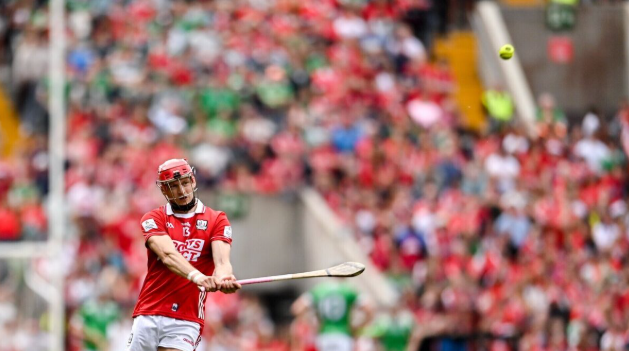
He’s a ‘Tik Tok influencer’ by all accounts. So fittingly, it was Alan Connolly that wielded his considerable influence on proceedings, nailing the free to tip Cork in front as additional time tick-tocked its way to a conclusion. Now so, that’s Tik Tok, Instagram and [checks notes] Pinterest referenced so far this year, which confirms that this blog remains firmly at the cutting edge of digital culture, fully in tune with the rhythms of modern life. As for the man himself, well, while his pre-championship remarks may have struck those on the outside as needlessly hubristic and reckless, perhaps he was exactly the man we needed in that moment. A player that could saunter out to midfield with unerring self-assurance and draw on his steadfast belief that yeah “when we’re at our best, I don’t think anyone can beat us”.
Cork were far from their best. The storm broke early, as it did in the corresponding fixture last year. That sweltering day in the Gaelic Grounds, Cork shipped so much water that the distress flares were already in the air by half-time. This time though, they managed to steady themselves, plugging the leaks and trimming the sails just enough to ride it out until the worst had passed. On eighteen minutes, Kyle Hayes burst through, emboldened by the spacious offerings of the opening quarter. Eoin Downey and Mark Coleman shut the door on him, and Downey made sure Hayes knew it too, driving home the point that whatever the scoreboard said, this wasn’t going to be Limerick’s playground any longer. A minute later, Barrett struck, and by half-time it was Limerick, not Cork, who looked in greater need of it. As O’Connor remarked afterwards, “Maybe us on the sideline might have panicked a small bit, but the boys inside didn’t seem to panic at all”, intimating perhaps at previous failings. Another step then. Calmer. Steadier.
Add to that the composure they showed late on to see it out, and you begin to sense something shifting. Limerick’s once ironclad aura no longer feels quite so impenetrable, and Cork, more than most, have played a role in chipping away at that veneer of invincibility. We’d beaten them in classics before. Last year, we beat them in a scrap. Each time, it demanded heights we weren’t entirely sure this team could reach. So to come through against Limerick while operating, for long stretches, far below optimum level points to a new resilience and a reassuring truth; we no longer need to be flawless just to compete. Thank God for that. Because some of the old flaws and frailties we’d hoped were behind us may yet reappear in the weeks ahead. And so, even with four points on the board, an unfamiliar vantage point at this juncture, it’s with a certain unease that we glance down at those beneath us.
This isn’t how it’s supposed to feel, nor is it the narrative that should be taking shape. Sunday afternoon delivered yet another epic between the championship’s two leading contenders, another statement win and more boxes ticked on the long road back. Yet all of that has been quickly eclipsed. The news that filtered out around Cork at Monday lunchtime quickly drained whatever euphoria lingered from Sunday’s win. Joyce’s injury had looked serious, yes, but there was still a hope it might prove less severe than first feared. After all, we’d seen it before; Brian Hayes crumpling against Galway in last year’s league, only to return and make his mark in the championship four weeks later. This time, though, there was to be no such reprieve. Any fortune that smiled on Cork last season has sharply reversed. Joyce is ruled out for the year, and Robert Downey now looks set to miss the remainder of the Munster campaign, a second blow that strips Wilde’s famous line of all satire. To lose one defender may be regarded as misfortune. But to lose both begins to invite questions you’d rather not have to answer.
What is the answer? The shift in perspective since Sunday evening has only reinforced how central Joyce and Downey are in the 3 and 6 jerseys, while laying bare the shortage of credible replacements. The sample size for Joyce at full-back may be limited, but what we have seen so far tells its own story, his handling of Shane O’Brien in the league final and John McGrath up in Thurles illustrating a hurler whose immense talents readily adapted to the role. Would it be courting alarmism to suggest that, of all the players that injury could have befallen, the loss of this All-Star defensive spine represents the most costly blow? Let’s say, for argument’s sake, it was Barrett or Fitzgibbon. As damaging and all as that would be, you could at least point to alternatives and talk about the next man stepping in. This is different. There’s no clear successor to Joyce, as the league already hinted, while in Downey’s case, any fix may have to be pulled from elsewhere on the field. Whatever defensive structure or cohesion that begun to take shape now feels unravelled, and being forced back to the drawing board in May could yet prove a serious setback.
In 279 BC, when Pyrrhus of Epirus defeated Rome at the Battle of Asculum, it too came at a ruinous cost. His battle-hardened Epirotes, the core of his army, suffered heavy losses, and with reinforcements scarce, each man was irreplaceable. The decisive breakthrough never came and Pyrrhus and his men eventually returned home, their dreams unfulfilled. If Cork’s All-Ireland campaign begins to unravel in the weeks ahead, the roots of that decline may be traced back to their own Battle of Asculum last Sunday; a result that, for all its value, may prove the very definition of a Pyrrhic victory.
But if Cork are to thrive, if their season isn’t to perish on the rocks of misfortune, they would do well to take their lead from Connolly, draw on that unshakeable self-belief and echo the message he set out in Nowlan Park back in March. Keep winning. Keep winning. That’s our goal. That’s what we’re going to do. Oh, for the confidence of youth.
Up the Rebels


Leave a Reply